Thursday, April 15, 2010

The Road to Mendoza

Crossing the Andes was not an experience we had considered much. We had thought about how much it would cost, what mode of travel, whether to go by day or by night, how long it would take. We thought of Mendoza, Argentina as our destination, but did not think of the crossing of the Andes as an experience itself. Perhaps we should have, because the road to Mendoza is both a geographical and historical marvel.

The first thing you notice when you approach the Andes is its highest peak; while the spine of the mountain range is a barren blade of greyish brown, a single peak is capped in white. This is Aconcagua, at 6962m above sea level she is the highest peak in the world outside of Asia and her snowmelt is one of the primary sources of the river system that runs into Mendoza.


The Andean border between Chile and Argentina is formed naturally by the Andes mountains themselves, but where exactly one country ends and the other begins has been a source of history between the two nations. Aconcagua is definitely Argentinian, because her water flows to the Argentinian side of the range, but border definitions have not always been so clear.

La Cumbre Pass is the name of the valley through which the road to Mendoza winds, a steep mountainous climb on the right side leads you to the historic monument named Christ the Redeemer of the Andes. This statue was erected in 1904 to celebrate the peaceful resolution of a border dispute between the two nations which came very close to war. If it wasn't for the efforts of a wealthy and highly religious Argentinian socialite, who arranged for the statue to be erected here, Chile and Argentina, both deeply catholic countries, may have resolved their differences by killing each other. Instead they decided to have a parade with gun salutes and lots of hugging and cheering.


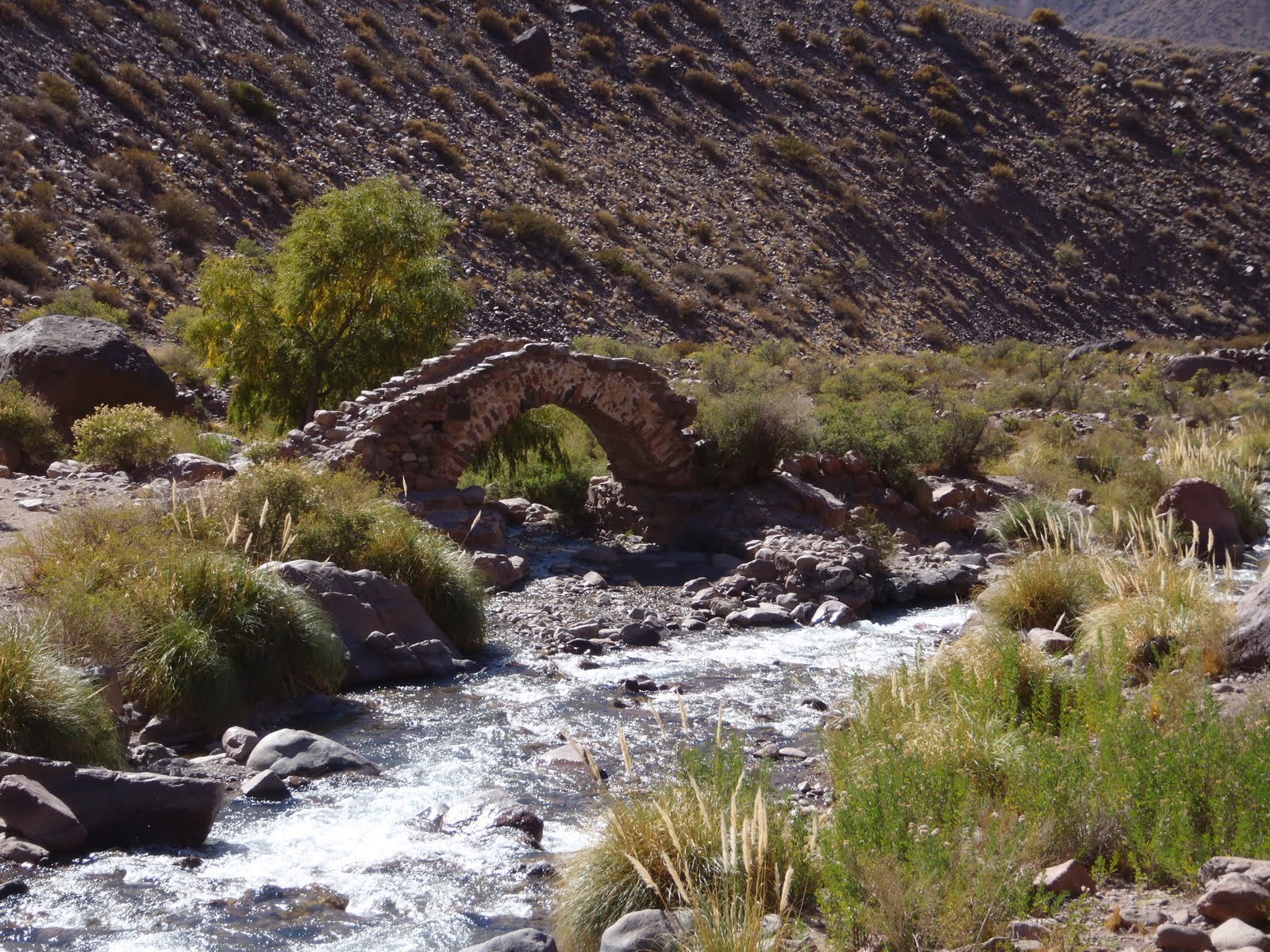
In Uspallata pass, also on the way to Mendoza, is a bridge named Picheuta. Back in 1817 a General with Republican ideas named San Martín formed an army with the intent of kicking the Spanish out of South America altogether. It was here at Picheuta that a sentry of San Martín's army first contacted the Spanish army that occupied the Chilean side of the Andes. Later, San Martín went on the liberate Argentina, Chile and Perú from Spain, San Martín is a bit of a hero to the Argentinian people in particular. A statue of Genral San Martin is found at San Martín Plaza in Mendoza, being the place where his 'Army of the Andes' was raised in the first place.

The bridge at Picheuta

Statue of San Martín in Mendoza

When your time passing through the Andes is almost done, you pass the Potrerillos dam, which dams the Mendoza river to form a large artificial lake. Mendoza has very little rainfall, but the combination of persistent sunshine from the arid climate and plentiful water supplied from the snowmelt of the Andean peaks makes for perfect conditions for growing grapevines, a fact that Mendocinos (people from Mendoza) have taken full advantage of.


Mendoza and the surrounding region supplies 80% of Argentina's wine, the vineyards are irrigated by a series of free flowing channels originally created by the Hualpa Indians of the region, and further developed by the Spanish for the agriculture of grapes, olives and lots of other fresh produce.

Mendoza is famous particularly for its Malbec wines, a variety we don't see much of in Australia. Malbec is similar to Shiraz but softer and lighter in character, and Mendoza is responsible for supplying very fine Malbecs at rediculously cheap prices when compared to Australian wine. At the Carmine Granata winery, Marina explains to us that the 2007 Cab Sav we are anjoying is selling for 18 pesos per bottle, and the Malbec for 28 pesos, or around $6-$9 Australian a bottle. For 280 pesos you can pick up a bottle of the 1999 Nicolas Granata Malbec, national and international gold medal winner and regarded by the people who decide such things as the second best Malbec in the world.

So for us, the road to Mendoza ends with a warm welcome in the form of some of Argentina's finest wine and food, the only tinge of sadness being that almost none of the wine here is exported to Australia. We will have to drink enough of it while we are here.

Jace wonders if he can fit the barrel in his pack. Scrap the pack, just take the barrel!

Meanwhile, Alix enjoys as much as she can

The fabulous spread at Casa de Cuno ends our tour of the Mendoza wine region

Saturday, April 10, 2010

Santiago

With a mischievous smile, Lucho explains that we might get another 'replica'; an aftershock of the earthquake.

Apparently on Monday night we had an earthquake of 4.5 magnitude, but Alix and I slept through it. The authorities on these matters predict a much larger earthquake will hit Santiago again within the next 12 months, and with the recent quake in Indonesia it would seem that the earth is scratching at her fleas with some vigour these days.

Understandably, the earthquake is the great topic of conversation in Santiago right now. Just hearing the different stories of where people were and how they reacted when it hit is fascinating, and surrounded as we have been by a wonderful array of family and friends the opportunities to do so have been several.

In a few short days we have met Lucho and Carmen's daughter, Daniela, and her family with husband Juan José and her six children. We visited Daniela at her beautiful home in Calera de Tango, where we drank lemonade and Juan José cooked BBQ pork- an excellent cut of meat they have here called malhaya, it is a thin, flat band of muscle that fits snug to the pig's stomach, and when cooked and salted it is lean and delicious. Daniela's house was quite undamaged in the earthquake, the only thing I noticed was a crack at the bottom of the swimming pool, which must have turned into a spa bath for a few minutes; when the quake was done the water level had dropped a foot or so from the spillage.

Daniela & Juan José's home is like an Italian villa

Lucho draws a turtle family for Poppy

Even dogs play soccer here

Cristo, the Modern Cowboy

The cowgirls, Poppy & Joséfina, with Lucho and Carmen

Malhaya

Negrito gets every last bit of salt and fat from the malhaya plate

La familia

We have also had the opportunity to meet some of Alix' relatives here in Santiago; the human connecting power of Yahoo!Messenger allowed Alix to meet her cousin Diego in cyberspace for the first time in 2005, and we were delighted to be invited to Diego's family home in Las Condes for dinner. The photo below is Diego and his family. Diego makes a cracking Pisco Sour.

Pablo, Jace & Diego behind Violeta, Alix & Verónica

Many of the museums and galleries a tourist might have visited while here are closed due to the damage the earthquake has caused, so instead of visiting the museums to see what is inside, you may visit them to see what happened to them instead. The other effect of the quake is a noticably large police presence on the streets, outside the Palacio de la Moneda there are police on every corner and more in two man patrols, there is even a riot bus casually parked a block away in a quiet side street.


All this authority has obviously had a calming effect, the people in Santiago are courteous and polite, the city is an orderly commercial machine like most other big, productive cities. Piñera is, Carmen describes, "a technocrat. We are sick of politics in Chile. Chile has no need for politics, what has politics ever done for us? Chilean people just want to get on with their lives."

In Santiago today you can see short term 12 month loans for 0.45% interest, so economic stimulation must be a high priority of the technocratic government. For the tourist the price of things, when compared with the knifing you receive at the cash registers of Sydney, Australia, is refreshing; two meals of steak or chicken washed down with a half bottle of excellent red wine served at your table with home made chilli relish and fresh crusty bread will set you back 8800 Chilean pesos, which translates to $18.39 in Australian money.

Most noticeable is the price of fresh produce, with mestizo farmers coming to market each day in the old fashioned way and hawking their wares. On the streets of Valparaíso you can pick up very cheap fruit and veges, especially avocadoes which seem to be a local staple; they have several different varieties here and the cheapest price we saw was 12 kilos of avocadoes for 1000 pesos, or about $2.20 Australian. Guacamole for everyone!

Palta = avocado; aceituna = olive

Apart from the avocadoes, Valparaíso, on the Chilean coast an hour and a half Northwest of Santiago, is quite an interesting place to walk around, the whole town is built into the sides of eleven different hills and the houses are seemingly all jumbled on top of each other like the city of Ankh-Morpork in Terry Pratchett's fantasy novels.

Further up the coast, we visited the aristocratic playground of Zapallar, an exclusive sea resort where the beautiful people of Santiago spend their summers swimming and sunbathing, playing tennis and polo, and generally being pampered by life. Don Olegario Ovalle, a ranch owner who owned the Zapallar bay decided he wanted to create the Zapallar resort, so he contacted his 18 closest friends and made them an offer; he would give them free land on the coast on the condition that they would build their houses within two years. And so, the most exclusive resort in Chile sprung up out of nowhere inside of 24 months, and though there are more people there now, it has remained Chile's most exclusive ever since.

Here we visited the summer house of friends of the Vargas', their beach-front mansion, in an old fashioned America-does-French-Country style, is a snapshot that appears frozen in 1905 when Don Olegario made the historic offer his friends couldn't refuse.

Zapallar

The beautiful people in Zapallar

The lounge room

Quaint ashtray holders

Closer to Santiago is Isla Negra, the small town where Pablo Neruda, Chile's nobel prize winning poet wrote his poems in his wonderful house. Owing to Neruda's obsession with things nautical, the rooms of the house are designed to look like the insde of a ship and it is furnished with an astounding collection of bowsprits, ships in bottles, insects stuck with pins, navigation instruments and other interesting paraphernalia. If you want to see more you will have to visit; photography is strictly forbidden inside the house itself.

Neruda started with the stone cottage on the left and added to it over the next 35 years to house his ever-increasing collection

The bar, housing one of the many bowsprits as well as a lot of bottles

Back in Santiago, Lucho kindly gave us a bit of a city tour, we ascended Cerro San Cristóbal and took a photo of Cerro Santa Lucía from the summit, somehow providing the impression that our time here was coming full circle as it complimented the photo of San Cristóbal we took from Santa Lucía some days before.
It was very hazy due to smog so Cerro Santa Lucía is not very clear

From San Cristóbal we visited the architecture school of the Catholic University, the school is built into an traditional Chilean farmhouse that was built by one Francisco Antonio Avaria in 1780. This hacienda was owned by the Martinez family as a working farm when Luis, a friend of the Martinez', was a youth, and Luis remembers visiting here in its working days. The building was sold very cheaply to the University in 1952, it is a two-storied open square of white-washed adobe enclosing a courtyard orchard of orange trees, the perfect scene for a movie with sombrero gunfights or puffy-sleeved sword duels. The building must have been well constructed as it has only the same minor damage from the earthquake as the concrete structures elsewhere in the city.

Lucho stands next to an adobe wall showing some of the earthquake damage

The courtyard with orange trees

To land in a foreign country and be welcomed by family and friends has opened the gateway to our journey in the most wonderful and warm way, and has inspired us with confidence to explore this New World.

Sunday, April 4, 2010

Sí, sí, habla con mi señora

Santiago de Chile.

When people in Santiago admire one another their gaze lingers a little longer than people do in Sydney- either that, or perhaps I only observed this behaviour amongst the construction workers at the airport, and tradesmen the world over are pervy in that way.

The flight was uneventful- three hotbox meals, three in-flight movies. After our mild confusion at the airport ("we thought you were running late", "no, we have been waiting in that tent over there for two hours!") we moved into Santiago, the first impression being of the airport road, Carmen and Luis pointing out the huge cracks in it caused by the earthquake.

The earthquake! What an experience it must have been, for three whole minutes the earth jumped, Carmen explains, not just up and down like most earthquakes but side to side as well, with such violence that a person could not stand up for fear of falling.

Santiago, far from the epicentre of the earthquake is only mildly affected, the Vargas' apartment is mostly unscathed. A good thing too, because it is a place of great beauty. You can see the cracks in the walls from the 8.8, especially above door frames or in front of metal pipes where they have jumped and rattled inside the walls.


The hallway that connects the rooms contains a single etruscan head sculpture on a thin dias that lances from the parquetry floor to the ceiling and from it the dining room is on the left, where a section of the glass tabletop, which had a tiny crack in it before the earthquake, has split open in a wide arc.


In the lounge room a wooden japanese sculpture has collapsed into a jumbled pile of wooden blocks on the floor, but by and large the rooms and their wonderful sketches, paintings and murals are undamaged.


Of course the room we have seen the most of is our bedroom, as the jetlag has kept us asleep until 11am one morning, and then wide awake at 3.30am the next.

Alix and I have nevertheless made it out into the city for a couple of hours each day, taking in a few of the city sights, including Cerro Santa Lucía, a kind of a fort/monastery/park on a hill with a beautifully crafted terrace in honour of the Roman sea God, Neptune. We have lunched on the local "completos"- tasty hot dogs with guacamole, tomatoes and mayonnaise, the restaurant experience prompting Alix to brush up on her Spanish and for me to learn "No hablo castellano. Por favor, habla con mi señora":- "I don't speak Spanish. Please, speak with my wife."


Above, you can see the view from the top of Cerro Santa Lucía looking across to Cerro San Cristóbal.

Friday, April 2, 2010

Arrived

So we've finally arrived in Santiago de Chile.

The flight out of Sydney was delayed by about an hour because they had to do some "maintainence" while we sat on the plane, without food or water. [I only mention that last bit because we had a very rushed morning and only had an Up'n'Go each for breakfast.] We made up the time in the air and arrived in Santiago pretty much on schedule.

The airport is undergoing reconstruction after the earthquake a month ago, so we were a bit confused as to where to meet our friends, the Vargases, who were picking us up. After a bit of a wait, bolstered by café con leche and pain au chocolat, I finally caught sight of Lucho, who had sweet-talked his way into the airport to find us. Turns out you actually have to walk out of the building, across and under some roads and into a white tent in the corner of the carpark as people who aren't flying are not allowed in. Naturally, no one told us this as we exited customs and there were no signs; plus, of course, some people managed to sneak in somehow and met friends/family at the gate, which confused Jace & me, so we waited inside instead of going out the doors.

Anyway, we were eventually in the car heading for Santiago proper, and the Vargases' gorgeous apartment. Will post more soon including some photos...

Monday, March 22, 2010

immunizations

When you are travelling through South America and Africa, God has created all kinds of bad juju that can mess with your lifestyle. Here are the ones you would be wise to get innoculated against:

Yellow fever
Hepatitis A & B
Tetanus
Diptheria
Typhoid
Meningitis
Polio
Cholera
Swine Flu
Rabies

You also need Doxy to safeguard against malarial mosquitoes when you are "in the J".

Sunday, March 7, 2010

Fire Sale

We're selling the following items, if anyone's interested:

- my car (Ultra Blue Holden Astra CDX MY06, ~58K km, leather seats, front heated seats, tinted windows, $20K)
- queen-size bed incl. mattress + linens
- 6x pillows
- 3-seater lounge with queen-size bed SOLD
- 3-seater lounge
- 2x coffee tables
- 2x DVD/CD towers SOLD
- small bookshelf
- tall boy
- chest of drawers SOLD
- fridge
- Hoover 3.5kg dryer SOLD
- 2x laptops SOLD
- large bar heater
- small bar heater
- left-handed desk
- hanging rack
- weights set
- iron & ironing board SOLD
- large rubbish bin, near-new
- fan
- Dyson vacuum cleaner
- Nilfisk vacuum cleaner SOLD
- size 8 Scarpa Kailash men's hiking boots, worn once

Leave a comment or email us if you're interested in any of the above. First come, first served. Goods will be posted on Gumtree/eBay in a week.

The kit list

alarm clock
map of South America
electrical tape
ziplock bags
ear plugs
first aid kit
torch
sunscreen
insect repellent
personal documents (passport, travel insurance, DAN membership, dive logs, airline tickets, bookings for inca trail, SAE membership. Photocopies of these documents.)
Netbook
ipods & ipod charger
electrical adapter plug (220v to 240v)
swiss army knife
universal sink plug
wallet with cash
money pouch with cards and travellers' cheques
pegless clothes line
travel pillow
digital camera
wristwatch
mobile phone
travel journal
lonely planet guides
toiletries
sheet liners
camelbak
towel
sleeping bag
tent
sleep mat
camp stove
drybag
thongs
walking shoes
boots
black shoes
sandals
sports socks
GP socks
casual shorts
swimming shorts
icebreaker thermal leggings
long pants
dress pants
jeans
underwear
belt
t-shirts
dress shirt
icebreaker long sleeves
icebreaker long sleeve zip thru
icebreaker thermal top
windstopper jacket
Goretex shell jacket
cap
beanie
gloves
scarf
shemagh
sunglasses
padlocks & mesh pack cage
hip flask & shot glasses (kidding... actually, no, I'm serious)
glock 9mm and spare cartridges (just kidding)

Friday, March 5, 2010

In 4 weeks...

... we will be in Santiago! Can't believe it's so close. And there is sooo much to do before we leave.

Only one more week of work left for me, 3 for Jace.

Our farewell is next Saturday, from 4pm at Zanzibar in Newtown. See you then!

Wednesday, March 3, 2010

8.8

Well, it looks like we might be in for an interesting time on the first leg of our journey. The coast of Chile was hit by an 8.8 earthquake on Feb 27th and it threw up a tsunami that belted the coastal cities.

For the first few days it sounded to me like no great big deal, all I heard was that Bachelet refused UN aid, and the Vargases had none of their people hurt or anything, so if they have it under control, then no biggie, right? Well, a few days later Bachelet has had a rethink and the situation is bit more dire than she originally thought it was, apparently.

Chile has lost a huge number of vineyards and wineries and several cities have been smashed. Criminal gangs, some armed with rifles and hatchets have been looting and terrorising the population, prompting President Bachelet to deploy 14000 troops and place several cities under military imposed curfews designed to contain chaos and provide security for humanitarian aid. Perhaps surprisingly, the death toll is only in the 700's. Apparently they have been smashed like this before; Concepcion was flattened by an 8.3 in 1939 (30,000 dead) and then a 9.5 hit in 1960 (6000 dead)- the biggest quake ever recorded in the world. After that they built a lot of new buildings with advanced engineering in case it happened again. Way to go, Chile.

Concepcion, which seemed like a wonderful place to visit has been belted pretty badly and who knows where it will really be at when we arrive in a month's time. Chile is a robust place and they will get back on their feet sooner or later, I just hope they get their act together sooner rather than later.

In other natural disaster news, the rains came early and heavy in Peru's wet season and the rivers of Cusco burst their banks, flooding local villages and smashing the railway line. Mudslides have literally washed the railway tracks away in no fewer than four places, claimed 5 lives and smashed up 2000 odd homes in the area. As another consequence, there is no way to get to Machu Picchu until they fix the railway line, and the tourists who were stranded in Aguas Calientes had to be evac'd by chopper.

The Peruvian govt say that the railway line will be up again in April, but it seems more likely that April is an aspirational tourism department sort of a timeframe. I pity whoever has to deal with Alix if they don't have that train line up again by the time we get there in June.

Monday, March 1, 2010

The Inca Trail

Hi folks,

This is Jace. I just finished the booking for the Inca trail. Alix and I are booked to do the trek to Machu Picchu from June 18th to June 21st. I hear it is breathtaking. Quite literally, if you haven't acclimatised to the altitude properly before you start.